Why You’re Asking This Question
You picked up an acorn, and for a moment, you wondered. Thousands of these nuts drop every year, eagerly eaten by deer and squirrels, yet most humans walk right past them. That gap, a nutritious nut sitting ignored underfoot, makes no sense. And it starts to make even less sense when you discover that acorns fed entire civilizations for thousands of years.
The answer to why humans stopped eating them is inseparable from what they taste like. Fix the flavor problem, and the whole story unravels.
What Raw Acorns Taste Like
Bite into a raw acorn and you will not enjoy it. Raw acorns taste intensely bitter, astringent, and mouth-puckering, generally unpleasant in a way that goes well beyond ordinary bitterness. The sensation is less like eating something slightly off and more like your mouth is being chemically dried from the inside.
That drying, puckering quality comes from tannins binding to the proteins in your saliva. Your mouth registers this as a threat signal. It is not imagining things.
The Tannin Problem: Why Acorns Bite Back
Tannins act as a natural defense mechanism for the oak tree, discouraging animals from eating the acorns before they are ready to germinate. They bind to proteins in saliva, creating that dry, puckering sensation. The same compounds appear in red wine, tea, and unripe fruit, though at far lower concentrations.
Tannins and phytic acid are both present in acorns and can interfere with nutrient absorption by binding to those nutrients, causing digestive problems if consumed in excess. Raw acorns in significant quantities are genuinely hazardous, not just unpleasant.
The northern red oak is one of the most widely distributed high-tannin species across eastern North America, which means its acorns are also among the most commonly encountered by foragers who underestimate how much processing they require.
The good news: tannins are water-soluble. They can be removed. This fact is what made acorns a viable food source for millennia, and it is also what makes them viable today.
White Oak vs. Red Oak: Not All Acorns Are Equal
The flavor of an acorn depends almost entirely on which oak species produce acorns and how much tannin that particular tree concentrates in its nuts.
The bitterness of any acorn depends heavily on the species that produced it. This detail matters if you are foraging, and it explains why some historical cultures found acorns far easier to work with than others.
White oak acorns tend to have a milder, almost sweet undertone and are prized by foragers for their relatively low tannin content. Red oak acorns have higher tannin levels and require significantly more processing to become palatable.
| Acorn Type | Tannin Level | Raw Taste | Processing Time | Flavor After Leaching |
| White Oak (Quercus alba) | Low | Mildly bitter, slightly sweet | Shorter (hours) | Nutty, slightly sweet, chestnut-like |
| Red Oak (Quercus rubra) | High | Intensely bitter, astringent | Longer (days) | Earthy, rich, strong nutty flavor |
| California Black Oak (Q. kelloggii) | High | Very bitter | Long | Deep, complex, savory |
| Holm Oak (Q. ilex) | Very Low | Almost sweet raw | Minimal | Sweet, almond-like |
The Holm oak, native to the Mediterranean, is why some cultures could eat acorns with minimal processing. It is also why Iberian pigs fed on Holm oak acorns produce the distinct flavor in Jamón Ibérico.
White oak acorns are the most forager-friendly of the common oak varieties in North America because their tannin levels are low enough that cold-water leaching alone can make them edible within a few hours.
What Leached Acorns Taste Like
Remove the tannins, and the acorn transforms. Once leached, acorns take on a rich, nutty, slightly sweet flavor reminiscent of chestnuts or hazelnuts, with the exact taste varying depending on the oak species.
Roasted acorns develop deeper, more complex notes, closer to coffee or dark roasted nuts. Ground into flour, they produce a mildly earthy, slightly sweet base for breads and porridges that pairs particularly well with game meats and honey. The flavor profile is not exotic or difficult. It is familiar territory for anyone who has eaten chestnuts.
Acorns can be eaten whole or processed into oil or flour, which is then used in soup, porridge, cake, bread, and hot drinks. Korean cuisine still does this regularly. Dotorimuk, acorn jelly, appears on Korean tables today as a side dish with a smooth, tofu-like texture and a subtly nutty flavor.
How Acorns Were Prepared Across Cultures
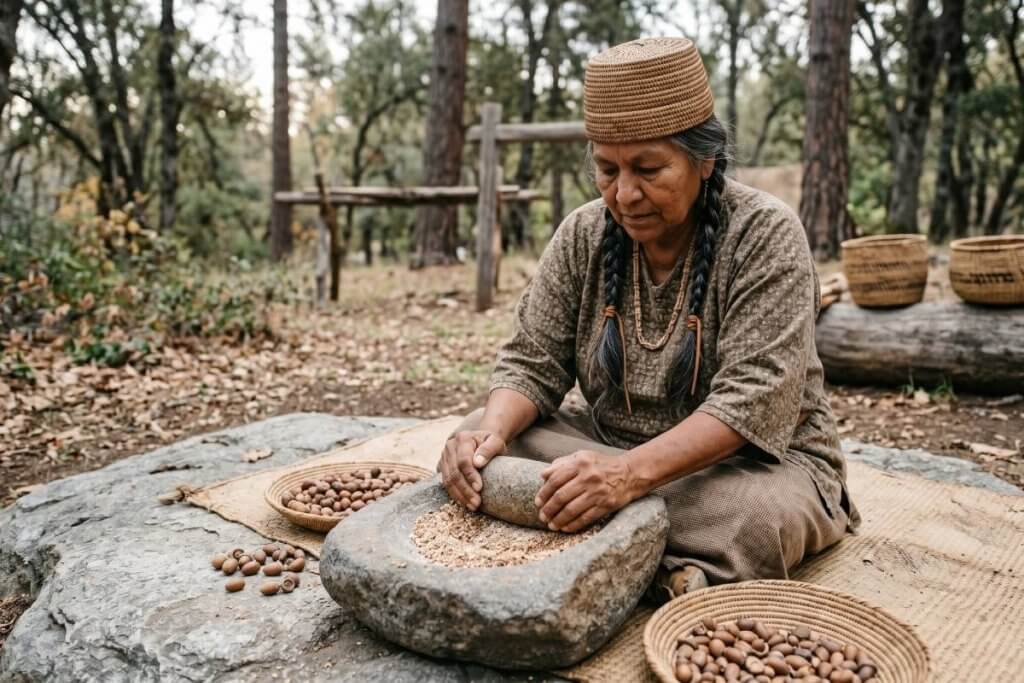
Throughout history and across continents, acorns were eaten raw, roasted, and boiled, and used to make oil, soup, mush, flour, coffee, and quick snacks. The Roman philosopher Pliny the Elder called the oak the tree that first produced food for mortal man, which gives a sense of how central acorns once were.
Regions including the Mediterranean, Asia, and North America processed and consumed acorns for thousands of years. On the North American West Coast, acorns made up more than half of the diet of native people. Tribes like the Pomo, Miwok, and Chumash in California developed sophisticated stone-grinding and leaching techniques that were passed between generations through oral tradition.
As recently as the early 1900s, acorns were widely used in the Mediterranean region, mainly Spain and Italy, for bread-making and as a coffee substitute. This was not a relic behavior. It was recent, documented, and widespread.
Why Humans Stopped Eating Acorns
This is where most articles give you a vague answer about agriculture. The real explanation has three distinct layers.
1. Agriculture Offered a Better Deal (Calories Per Hour of Labor)
Wheat, rice, and corn can be planted, tended, and harvested in a predictable cycle. Acorns require foraging, transport, cracking, grinding, and multi-day leaching before you have edible food. When alternatives like cultivated grains, legumes, or easier-foraged nuts exist, people prioritize those. Yield per hour is simply lower with acorns compared with other wild foods.
Agriculture did not just replace acorns. It made the time investment of acorn processing economically irrational for most populations.
2. Grains Store and Scale Better
Acorn harvests are seasonal and unpredictable. Most years, when oaks produce enormous quantities of acorns, alternate with low-yield years. Grain crops, by contrast, can be stored for years and traded across regions. As grain-based trade networks grew, the reliability advantage of grains compounded.
3. Cultural Knowledge Broke Down
Acorn processing requires specific knowledge: how to identify species, when to harvest, how long to leach, and what to do with the flour. Several cultures devised traditional acorn-leaching methods, sometimes using specialized tools, that were passed down to children by word of mouth. Once agricultural societies replaced foraging communities, that transmission chain broke. Within a few generations, the practical knowledge was gone, and acorns became “squirrel food” rather than “human food.”
Acorn Nutrition: What You’re Actually Missing
The irony of abandoning acorns is that they are genuinely nutritious. According to the USDA FoodData Central, raw acorns supply 387 calories per 100g and are a rich source of vitamin B6, folate, copper, and manganese.
Depending on the species, acorns can contain up to 18 per cent fat, 6 per cent protein, and 68 per cent carbohydrate, with the remainder being water, minerals, and fiber. They are also good sources of vitamins A and C and many essential amino acids.
Scientists have identified numerous beneficial plant compounds in acorns, including catechins, resveratrol, quercetin, and gallic acid, potent antioxidants linked to a lower risk of heart disease and cancer. The fat profile is predominantly unsaturated, similar to olive oil. Acorns are also gluten-free, making acorn flour a legitimate substitute for wheat in certain applications.
Can You Still Eat Acorns Today?
Yes, and the process is accessible. You do not need specialized equipment or days of outdoor labor.
Hot water leaching
Boil shelled, crushed acorn meat in several changes of water until the water runs clear and the bitterness dissipates. This takes a few hours and is the fastest method, though it gelatinizes some starches and limits use in baking.
Cold water leaching
Soak shelled, ground acorn meal in cold water, changing the water daily for three to five days. This preserves more starch structure and produces flour better suited to baking.
If you want to experiment with acorn flour or meal, you do not necessarily need to forage and grind it yourself. You can order it through specialty suppliers, health food stores, and online sources.
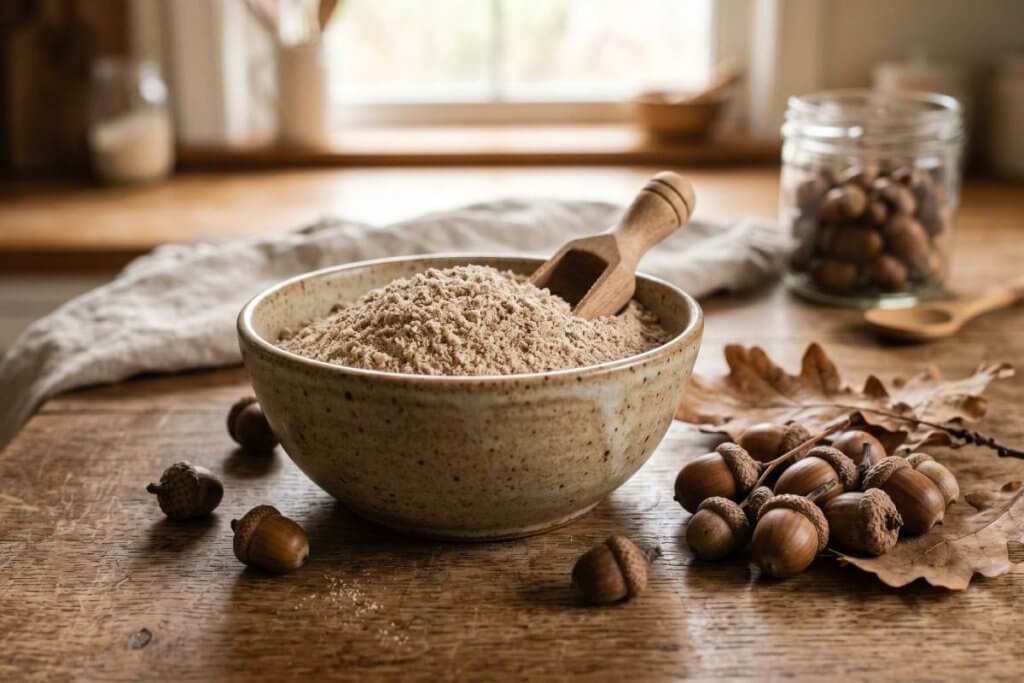
Over the past decade, various websites, magazines, and newspapers have recommended reintroducing acorn-based items into modern diets, driven by interest in foraging, local edible wild plants, and gluten-free ingredients. The revival is real, if still niche.
Conclusion
Raw acorns taste intensely bitter because of tannins, but once leached, they produce a rich, nutty flavor comparable to chestnuts or hazelnuts, with significant variation between white and red oak species. Humans did not stop eating acorns because they are inedible: they stopped because agriculture provided a more efficient, scalable, and storable alternative, and the processing knowledge gradually disappeared as grain-farming cultures replaced foraging ones. The food itself is nutritious, historically significant, and still entirely available to anyone willing to process it correctly.
FAQ
Q: Are acorns safe to eat raw? A: Raw acorns are not recommended for human consumption. Raw acorns contain tannins that can be toxic to humans, cause an unpleasant bitter taste, and are also harmful to horses, cattle, and dogs. By leaching acorns to remove the tannin through hot or cold water methods, they can be made safe and palatable for human consumption.
Q: What do acorns taste like after leaching? A: Once leached of tannins, acorns take on a rich, nutty, slightly sweet flavor reminiscent of chestnuts or hazelnuts, with the taste varying depending on the oak species involved. Roasting after leaching deepens the flavor further, producing earthy, coffee-adjacent notes. Acorn flour has a mildly sweet, wheaty quality that works well in flatbreads and porridges.
Q: Did Native Americans eat acorns? A: Acorns once made up close to 50 per cent of the diet of Native Americans living along the West Coast of the United States, and they are still used today to make acorn flour and soup. California tribes, including the Pomo, Miwok, and Chumash, developed sophisticated stone-grinding and water-leaching techniques passed down through oral tradition across generations.
Q: Why are acorns not sold in grocery stores? A: The barrier is almost entirely logistical. Acorns require seasonal hand-harvesting, cracking, grinding, and a multi-day leaching process before they are ready for consumption or milling into flour. No industrial-scale infrastructure exists to process acorns efficiently enough to compete on price with wheat, corn, or conventional nuts. Unless you are open to foraging, acorns can be difficult to find and are not available at most grocery stores, specialty suppliers, and online retailers carry acorn flour for those who want it without the field work.