Most people plant a “live oak” and assume they know what they’re getting. They don’t. Four distinct varieties carry that name, and they differ in size, cold tolerance, leaf shape, and preferred soil by a margin wide enough to kill a tree you planted in the wrong spot.
Planting a southern live oak where a Texas live oak belongs, or confusing a sand live oak with its coastal counterpart, costs you years of growth and potentially thousands in removal.
This guide breaks down each variety by the traits that actually matter: taxonomy, climate range, mature size, leaf morphology, and landscape use.
What Makes a Tree a “Live Oak”?
“Live oak” refers to any oak that retains its leaves year-round, making it functionally evergreen. The name has nothing to do with taxonomy and is applied loosely to several distinct Quercus species and varieties. The confusion is structural: the term lumps together trees that share an evergreen habit but differ in species, genome, and native range.
The U.S. Forest Service’s Silvics of North America recognizes two formal varieties of Quercus virginiana: Texas live oak (Q. virginiana var. fusiformis) and sand live oak (Q. virginiana var. geminata), distinguished primarily by leaf size and acorn cup shape. Coastal live oak (Q. agrifolia) is a separate species entirely, native to California, and shares only the evergreen habit with its southeastern counterparts.
Understanding which tree you’re dealing with starts with geography. If you’re east of the Rockies, you’re almost certainly looking at a Q. virginiana relative. If you’re in California, it’s Q. agrifolia.
Southern Live Oak (Quercus virginiana)
Size and Canopy
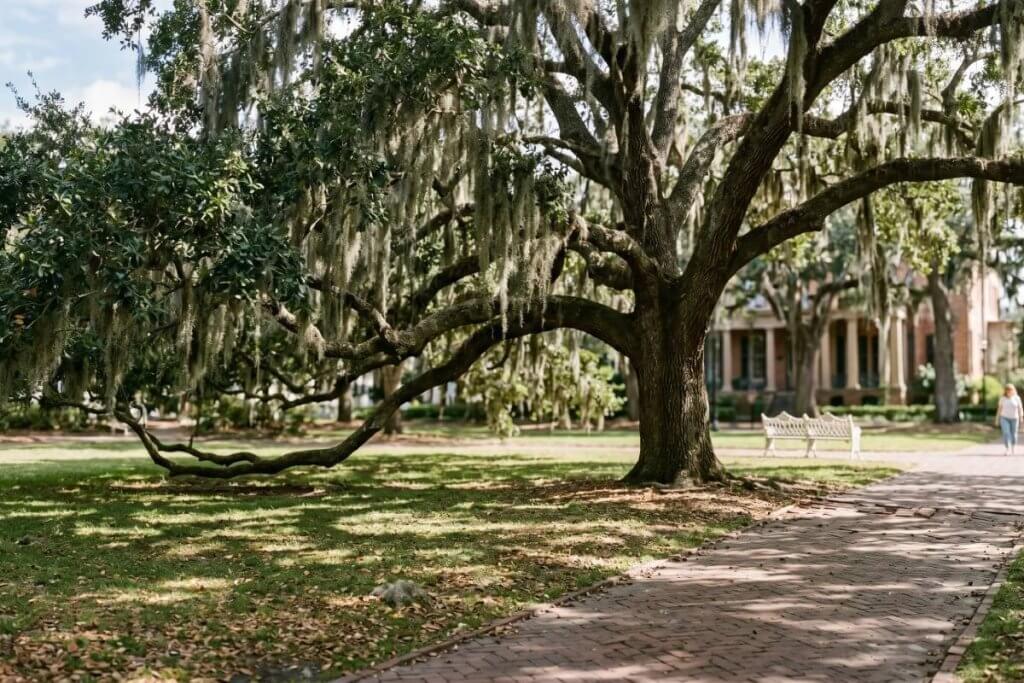
Southern live oak is the architectural centerpiece of the American South. On average, crown spread reaches 80 feet with a height of 50 feet, though the largest specimens push canopy diameters to 150 feet, nearly large enough to cover half a football field. Branches typically emerge from a single trunk that can reach five to six feet in diameter.
Growth is fast when young and slows significantly at maturity. These trees may reach close to their maximum trunk diameter within 70 years, and the oldest living specimens are estimated to be several hundred to more than a thousand years old.
According to UF/IFAS Extension, southern live oaks commonly reach 250 to 500 years in good growing locations, with maturity achieved around 75 years.
Habitat and Hardiness
Southern live oak occurs on the lower Coastal Plain of the southeastern United States from southeastern Virginia to Florida, including the Florida Keys, and west to southeastern Texas.It tolerates occasional flooding but not sustained saturation. Salt spray resistance is high, giving it dominance in coastal forest communities where competing broad-leaf species fail.
The species is reliably hardy to USDA Hardiness Zone 8a, placing its northern inland limit around Atlanta, Memphis, and Washington, D.C. It performs in both sandy and clay soils, though well-drained sandy loam produces the best growth.
Readers in the Mid-Atlantic or Midwest who want a large, long-lived native oak should know that northern red oak thrives in colder hardiness zones where southern live oak and its relatives cannot survive the winter.
Identifying Features
Leaves are elliptical to oblong, one to five inches long, with smooth or slightly rolled margins and a pale, silvery underside. The tree is not a true evergreen: it drops and replaces leaves over a few weeks in spring rather than holding them indefinitely. Acorns are dark brown, about an inch long, and in clusters of three to five.
Coastal Live Oak (Quercus agrifolia)
Size and Canopy
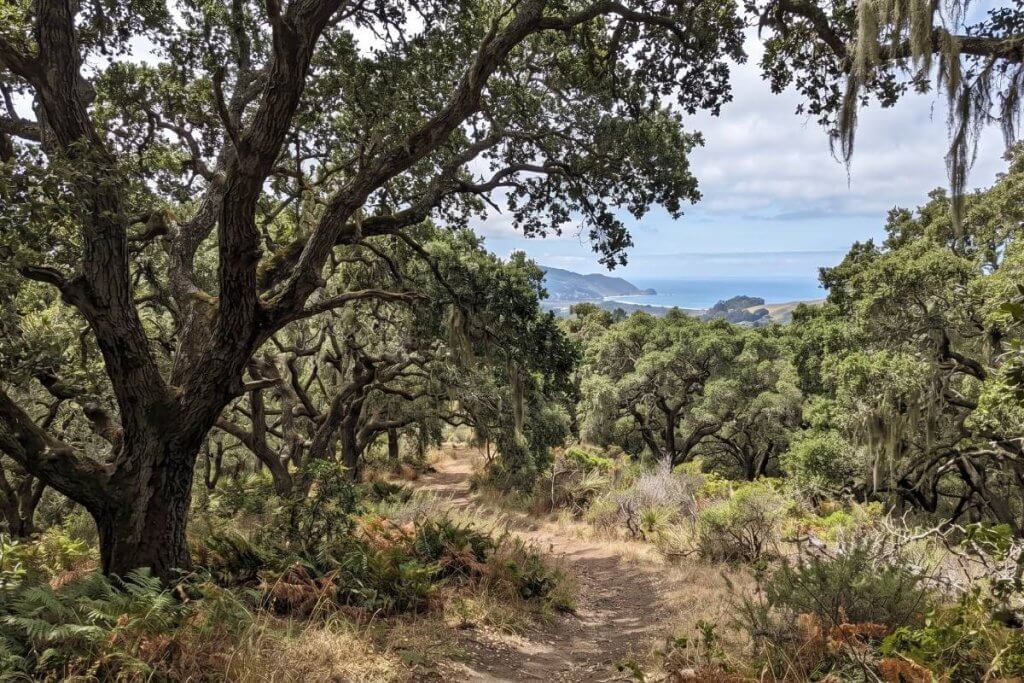
Coastal live oak is a California-native species with no direct taxonomic relationship to Q. virginiana. Mature trees reach 20 to 70 feet tall with a spread of 25 to 100 feet. The crown is typically dense and rounded, often with multiple low-branching trunks that give it a sculptural silhouette.
Growth rate is moderate, averaging 12 to 24 inches per year under ideal conditions. Specimens in the Santa Barbara and Monterey regions frequently exceed 300 years in age.
Habitat and Hardiness
Native range runs from Mendocino County in northern California south into Baja California, Mexico, almost exclusively within 50 miles of the Pacific coast. It grows in USDA Hardiness Zones 9 to 10, and its tolerance of summer drought is a defining characteristic: coastal live oak thrives in California’s Mediterranean climate, where summers are bone-dry for five to six months.
It grows in clay, loam, and rocky soils but is intolerant of poor drainage and prolonged wet conditions during summer. Planting it where irrigation runs through summer almost guarantees root rot from Phytophthora cinnamomi or sudden oak death (Phytophthora ramorum).
Identifying Features
Leaves are the clearest differentiator: Q. agrifolia has convex, cup-shaped leaves with spiny, holly-like teeth along the margins. This distinguishes it immediately from the flat, smooth-edged leaves of southern live oak. Acorns are slender and pointed, 1 to 1.5 inches long, with a thin, shallow cup, maturing in one season.
Sand Live Oak (Quercus virginiana var. geminata)
Size and Canopy
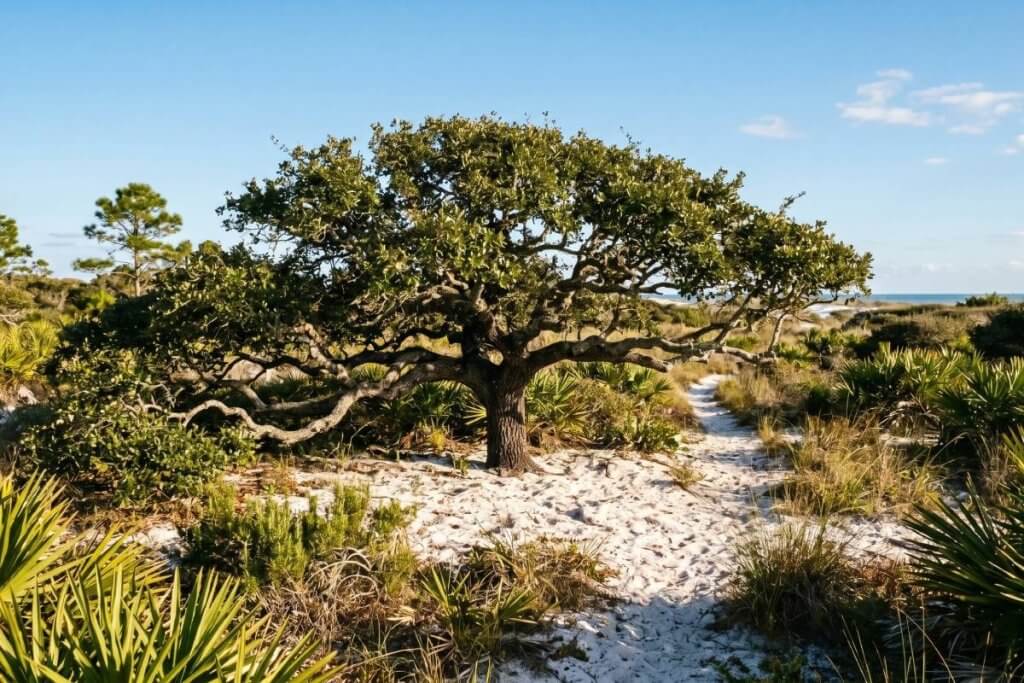
Sand live oak is the scrubby, underestimated member of the Q. virginiana complex. It rarely exceeds 20 to 30 feet in height, and in exposed dune environments, it often grows as a multi-stemmed shrub under 10 feet. That suppressed form is a response to wind exposure and nutrient-poor sand, not a permanent trait: in protected settings, it develops into a proper small tree.
Canopy spread is proportionally wide relative to height, typically 20 to 40 feet. The tree’s root system is deep and extensive, which makes it highly drought-tolerant and wind-resistant once established.
Habitat and Hardiness
Sand live oak is native to the sandy coastal plain and scrub habitats of Florida, Georgia, and the Carolinas. It grows on deep, infertile, excessively drained sands where southern live oak cannot compete. USDA hardiness falls in Zones 8 to 10. It is one of the most salt-spray-tolerant oaks in the Southeast, making it practical for beachfront stabilization plantings.
Florida’s inland scrub communities host the densest populations. The species frequently grows in association with Florida rosemary (Ceratiola ericoides), scrub hickory, and Chapman oak in xeric scrub ecosystems.
Identifying Features
Leaf size is the primary differentiator between sand live oak and the typical southern live oak: sand live oak has narrower, more revolute (rolled-under) leaf margins and smaller acorn cups. Leaves are typically 1 to 2.5 inches long, stiffer, and more elliptical than Q. virginiana. The undersides show the same pale, hairy coating as the southern variety.
Texas Live Oak (Quercus fusiformis)
Size and Canopy
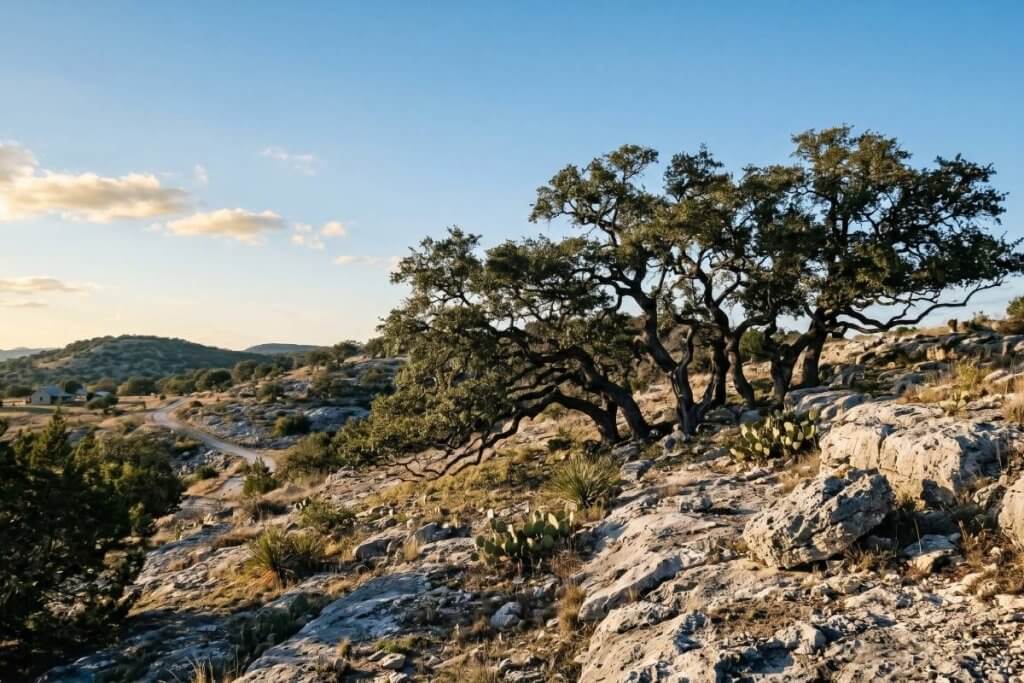
Texas live oak occupies the middle ground between a full-sized shade tree and a large shrub, depending on location. In Hill Country settings, mature trees reach 30 to 60 feet tall with a rounded crown spreading 30 to 50 feet. On exposed rangelands or rocky caliche soils, they often form multi-stemmed motts (groves), rarely exceeding 20 feet.
The tree is known for clonal root sprouting, producing connected colonies from a shared root system. A single mott can represent one genetic individual across a wide surface area.
Habitat and Hardiness
Texas live oak’s range extends through central and west Texas into southwestern Oklahoma and into northeastern Mexico. This is where it decisively separates from southern live oak: it handles hard freezes that Q. virginiana cannot. It is cold-hardy to USDA Zone 7a, making it viable in areas that regularly drop below 0°F for short periods.
Soil preference is calcareous (limestone-based) and rocky. It outperforms every other live oak on shallow caliche soils with low organic matter and high pH. Drought tolerance is exceptional; established trees survive on 15 to 18 inches of annual rainfall.
Identifying Features
Leaf shape overlaps with southern live oak but runs smaller, typically 1 to 3 inches, with a slightly more oval form. Acorn cup shape is the most reliable field diagnostic: Texas live oak produces acorns with a deeper, more turbinate (top-shaped) cup compared to the shallow cup of Q. virginiana. The taxonomic debate over whether Q. fusiformis deserves full species status (rather than variety status under Q. virginiana) remains active among botanists, though many authorities now treat it as a distinct species based on cold hardiness, leaf morphology, and geographic separation.
Side-by-Side Comparison Table
| Feature | Southern Live Oak | Coastal Live Oak | Sand Live Oak | Texas Live Oak |
| Scientific Name | Quercus virginiana | Quercus agrifolia | Q. v. var. geminata | Quercus fusiformis |
| USDA Zones | 8a–10b | 9–10 | 8–10 | 7a–9 |
| Mature Height | 40–80 ft | 20–70 ft | 10–30 ft | 30–60 ft |
| Canopy Spread | 60–150 ft | 25–100 ft | 20–40 ft | 30–50 ft |
| Leaf Margin | Smooth, flat | Spiny, convex | Rolled under | Smooth, slightly oval |
| Leaf Length | 1–5 in | 1–3 in | 1–2.5 in | 1–3 in |
| Preferred Soil | Sandy loam, clay | Clay, rocky, loam | Deep infertile sand | Rocky calcareous |
| Drought Tolerance | Moderate | High | High | Very High |
| Salt Spray Tolerance | High | Low–Moderate | Very High | Low |
| Cold Hardiness | Moderate (Zone 8a) | Low (Zone 9) | Moderate | High (Zone 7a) |
| Native Range | SE United States | Coastal California | FL, GA, Carolinas | TX, OK, NE Mexico |
| Acorn Cup Depth | Shallow | Thin, shallow | Shallow | Deep, turbinate |
| Clonal Sprouting | Rare | Rare | Occasional | Common |
Which Variety Should You Plant?
The answer depends on three variables: your USDA zone, soil type, and mature size tolerance.
Zone 7a to 8a with limestone or calcareous soil:
Plant Texas live oak. It’s the only variety with proven cold-hardiness in that zone and the only one that thrives in high-pH rocky soils. Attempting southern live oak in Zone 7 will result in dieback after a hard freeze.
Gardeners in Zone 6 and colder who are drawn to a broad spreading canopy should look at bur oak and swamp white oak, both of which tolerate winters that would kill any live oak variety outright.
Zone 8b to 10 in the coastal Southeast:
Southern live oak is the correct choice for lawns, streets, and parkways. Its canopy spread of up to 150 feet demands property widths of at least 60 feet for a single tree to reach its potential without conflict.
Florida scrub, coastal dunes, or beachfront stabilization:
Sand live oak outperforms every other variety on deep, infertile sand with salt exposure. Its low height and shrubby growth form also make it appropriate for screens, buffers, and understory planting beneath taller pines.
California, Zones 9 to 10:
Coastal live oak is the only live oak that belongs here. Do not import southern live oak to a California landscape expecting the same result. The two species have different water relationships and pest vulnerabilities, and the southern live oak requires supplemental summer irrigation that the coastal live oak cannot tolerate without disease.
Live oaks are far from the only candidates for large-property planting, and homeowners evaluating them should also consider the broader range of types of oak trees suited to residential yards before committing to a species.
Conclusion
Four trees carry the “live oak” label, but they occupy different geographies, soil types, and climate zones with enough separation to make species selection a critical decision. Southern live oak dominates the coastal Southeast, coastal live oak defines California’s oak woodlands, sand live oak fills the scrub and dune ecosystems of Florida and the Carolinas, and Texas live oak holds limestone hillsides and cold-exposed rangeland where no other live oak survives. Match variety to site conditions first, and the tree will take care of the rest.