You’ve narrowed your oak selection down to two species, and they look almost identical at a glance.
The problem is that bur oak and swamp white oak have fundamentally different site requirements, and planting the wrong one in the wrong soil can result in iron chlorosis, stunted growth, or outright transplant failure.
This guide covers everything about bur oak: how to identify it, how it grows, what it needs, and how it stacks up against swamp white oak so you can make the right call for your specific site.
What Is a Bur Oak?
Bur oak (Quercus macrocarpa Michx.) belongs to the White Oak group (Fagaceae) and carries one of the widest native ranges of any North American oak. Its distribution spans the eastern United States and the Great Plains, from southern New Brunswick west across the continent. It extends farther north into Canada than any other oak species.
It grows slowly on dry uplands and sandy plains but is also found on fertile limestone soils and moist bottomlands in a mixture with other hardwoods. In the west, it acts as a pioneer tree invading prairie grasslands, and it is frequently planted in shelterbelts.
Congress designated the oak as America’s national tree in 2004. Bur oak belongs to a broader group of native oak trees for yard planting, each suited to different soil conditions, drainage levels, and canopy size requirements. It sits within the White Oak group alongside swamp white oak, chinkapin oak, and white oak proper.
How to Identify a Bur Oak
Leaf Shape
Bur oak leaves are large, typically 8 to 12 inches long and 4 to 8 inches wide. The critical ID marker is the deep pair of sinuses roughly in the middle of the leaf, which creates a distinct “cross” or “fiddle” shape. The upper lobes are rounded and larger than the lower ones. Swamp white oak leaves lack these deep sinuses.
Bark and Branches
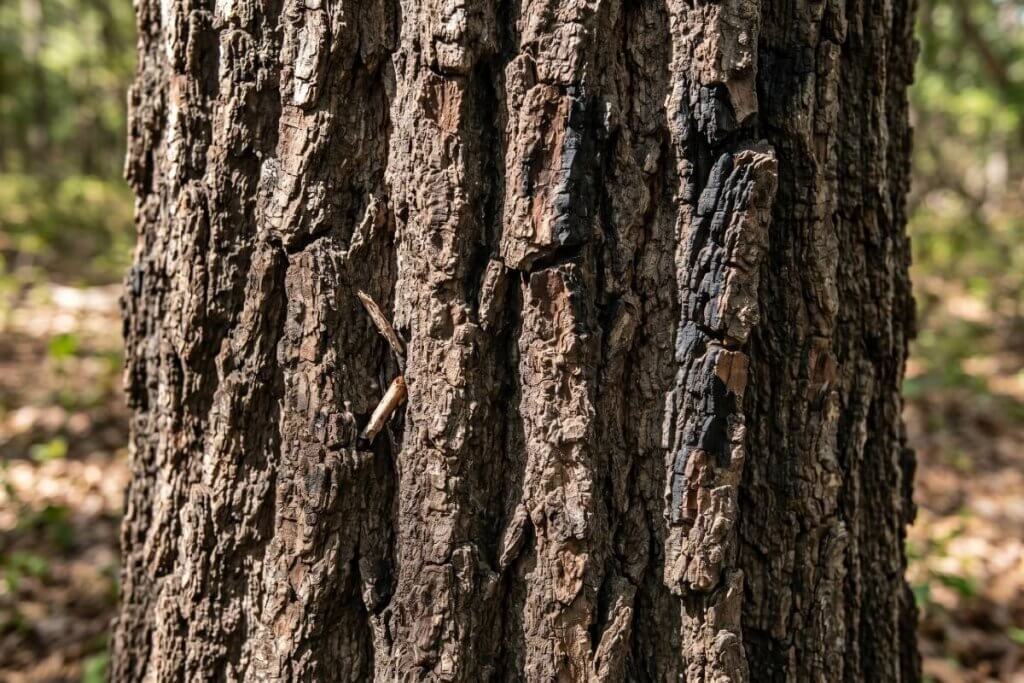
Young bur oak branches develop prominent corky, ridged bark, a feature that no other common oak replicates this strongly. On mature trees, the trunk bark turns dark gray with deep, irregular furrows. This corky branching is the most reliable winter identification tool when leaves are absent.
Acorns
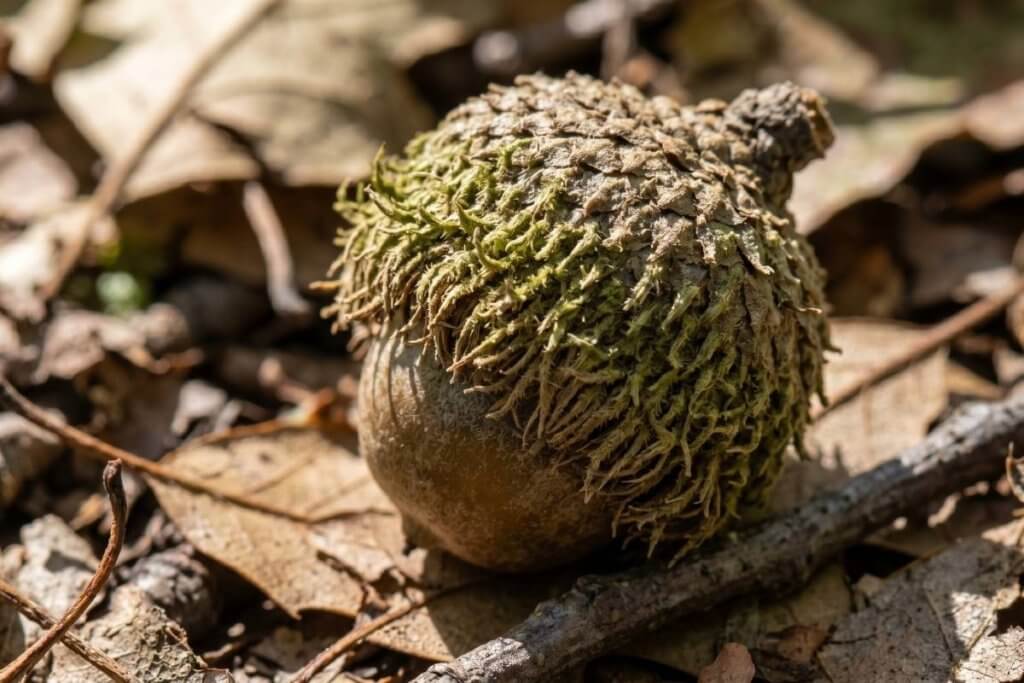
Bur oak has the largest acorns of all native oaks and is easily identified by its acorn cap, which covers at least half of the nut and is fringed with elongated, mossy-looking scales that form a “bur” around the rim. That fringe is what names the species. Swamp white oak acorn caps are smaller and lack the fringe.
Growth Rate and Mature Size
Bur oak is a slow-to-medium grower. Initial height growth is normally slow for the first 3 to 5 years, dependent on environmental conditions, particularly sun exposure. During this early phase, the tree prioritizes deep taproot development over above-ground growth, which is exactly why it achieves such exceptional drought resilience later.
Once established, bur oak typically gains 12 to 14 inches of height per year. Mature specimens reach 60 to 80 feet tall with a crown spread of equal or greater width. In ideal conditions, some individuals exceed 100 feet. Bur oaks have a lifespan exceeding 200 years, approaching 1,000 years.
The wide, open crown with heavy, spreading branches makes bur oak one of the most commanding shade trees in the native oak palette. The canopy can be as wide as the tree is tall.
Soil, Site, and Hardiness Requirements
Bur oak is the most site-adaptable oak in North America. It can tolerate soil that consists of sand or gravel, and in very harsh conditions, it can adapt by growing as small trees or shrubs.At the other end of the spectrum, it thrives on fertile limestone bottomlands.
Bur oak prefers calcium-rich soils and handles alkaline pH (up to 8.0) without the iron chlorosis that cripples pin oak and swamp white oak on high-pH sites. It is hardy in USDA Zones 3 through 8, tolerating both the cold of southern Canada and the heat of central Texas.
Full sun is required. Bur oak does not perform in shade. Transplants establish best in spring, and the deep taproot means bareroot or early container-grown stock outperforms large balled-and-burlapped specimens.
Drought Tolerance and Fire Resistance
Bur oak’s taproot penetrates deeply into the soil profile before leaves even fully expand. Root growth of juvenile bur oaks is rapid, and the taproot penetrates deeply into the soil before the leaves unfold. This gives established trees access to moisture that shallow-rooted species cannot reach during drought.
Because of its thick bark, bur oak is the most fire-resistant of all oak species. This trait is why bur oak historically dominated the oak-savanna transition zone, where periodic prairie fires kept other tree species in check. Grasses killed by surface fires rarely damage mature bur oaks.
Although bur oak seedlings can endure flooding for up to 30 consecutive days during the growing season, root growth is greatly reduced, thus reducing drought tolerance after flood waters have receded. On chronically wet sites, swamp white oak is the stronger performer.
Wildlife Value
Bur oak’s large acorns deliver an outsized mast crop. The acorns become an important source of food for wildlife. Timing and cap coverage vary considerably in acorn production across native oak species, with bur oak’s large fringed-cap acorns ranking among the highest wildlife-uptake mast crops in the white oak group, attracting deer, wild turkey, squirrels, blue jays, wood ducks, and bears. The large cap-to-nut ratio does not reduce palatability. White oak group acorns are lower in tannins than red oak group acorns, making them preferred by most wildlife.
University of Delaware entomologist Doug Tallamy, cited by the National Wildlife Federation, found that native oaks host more than 1,000 species of moth and butterfly caterpillars, more than any other North American tree genus. These caterpillars are the primary protein source that songbird parents use to raise nestlings.
(Source: National Wildlife Federation, National Wildlife magazine, Fall 2024)
Beyond insects and mammals, oaks provide forage, nesting, and other habitat for birds, mammals, and fungi, and act as foundational species that control wildlife populations and community dynamics. No other genus in the North American tree palette delivers comparable ecological leverage per tree.
How to Care for a Bur Oak
Pruning
Prune only between December and February. Oak wilt (Ceratocystis fagacearum) spreads through fresh pruning wounds in spring and summer when bark beetles are active. Winter pruning eliminates that vector.
Fertilization
Established bur oaks growing in native soil rarely need fertilization. Over-fertilizing stimulates rapid soft growth that increases disease susceptibility. On genuinely nutrient-depleted urban soils, a soil test should guide any amendment.
Pests and Disease
Bur oak is susceptible to oak wilt, anthracnose, and gypsy moth defoliation. It is prone to gypsy moths and susceptible to anthracnose, with intermediate preference by orange-striped oakworms. A single defoliation by gypsy moths rarely kills a mature bur oak, but repeated defoliations stress the tree significantly.
Watering
Water deeply during the first two growing seasons to support taproot development. After year three, established bur oaks rarely need supplemental irrigation outside of extreme drought.
Bur Oak vs Swamp White Oak: Full Comparison
Bur oak and swamp white oak are visually similar and can occur in the same habitat where their ranges overlap. However, certain key characteristics of bark, leaves, and acorns can usually distinguish them. These two species can hybridize and intergrade, so it may not be possible to identify all individuals.
| Feature | Bur Oak (Q. macrocarpa) | Swamp White Oak (Q. bicolor) |
| Mature Height | 60-80 ft (100 ft max) | 50-60 ft |
| Crown Spread | 60-80+ ft | 50-60 ft |
| Growth Rate | 12-14 in/yr (after establishment) | 13-24 in/yr |
| USDA Hardiness | Zones 3-8 | Zones 4-8 |
| Soil pH Tolerance | 6.0-8.0 (alkaline-tolerant) | 5.0-7.4 (acid-tolerant; chlorotic above 7.5) |
| Moisture Range | Dry uplands to moist bottomlands | Moist to wet bottomlands preferred |
| Drought Tolerance | Excellent (deep taproot) | Moderate once established |
| Flood Tolerance | Up to 30 consecutive days (seedling) | High wet-site specialist |
| Bark (Trunk) | Dark gray, deeply furrowed | Shallowly furrowed, flatter plates |
| Bark (Branches) | Corky, rigid diagnostic | Exfoliating/peeling diagnostic |
| Leaf Shape | Deep sinuses, fiddle/cross shape | Shallow lobes, no deep central sinuses |
| Acorn Cap | Covers 50%+ of nut, burred/fringed | Covers 30-50%, no fringe, scaly |
| Fire Resistance | Highest of all North American oaks | Moderate |
| Alkaline Soil | Tolerates well | Develops chlorosis above pH 7.5 |
| Lifespan | 200-1,000 years | 150-300+ years |
| Hybridizes With | Swamp white oak (Q. x schuettei) | Bur oak (Q. x schuettei) |
Swamp white oak is one of the easiest oaks to transplant and is more tolerant of poor drainage than other oaks. Avoid high pH soils, or plants may develop chlorotic (yellowing) leaves.
The hybrid between these two species, Quercus x schuettei, occurs naturally where their ranges overlap. It combines the best characteristics of both parent oaks, such as alkaline soil tolerance and poor drainage tolerance, and also has hybrid vigor, growing faster than both of its parent species.
Which One Should You Plant?
Choose bur oak if:
- Your soil is alkaline (pH above 7.0)
- Your site is a dry upland, clay plain, or sandy prairie
- You need a tree that withstands periodic drought with zero supplemental irrigation after establishment
- You want maximum longevity and the largest possible crown at maturity
- Your region gets prairie-style fires or high-wind exposure
Choose swamp white oak if:
- Your site has poorly drained, consistently moist, or seasonally flooded soil
- Your soil is acidic (pH 5.0 to 7.4)
- You need a faster-growing canopy tree
- You want exfoliating bark for winter ornamental interest
- Gardeners on acidic, well-drained sites who rule out both species should also evaluate Shumard oak, a red-group native with faster growth and stronger performance on sandy, low-pH ground.
Consider Q. x schuettei if:
- Your site is urban, with both alkalinity challenges and periodic flooding
- You need a street-capable tree with faster establishment than either parent
Conclusion
Bur oak is the most ecologically and physically resilient native oak in North America, built for alkaline soils, drought, fire, and centuries of use. Swamp white oak targets a completely different niche: moist, acidic bottomlands where bur oak merely survives rather than thrives. Match the species to your specific soil pH and drainage, and either tree will pay dividends in wildlife value and canopy quality for generations.
FAQ
How fast does a bur oak grow? Bur oak grows slowly for the first three to five years after planting, typically adding less than 12 inches of height annually while it establishes its deep taproot. After year five, growth accelerates to 12 to 14 inches per year. The slow early phase is not a sign of failure — it reflects the tree investing in root infrastructure that will sustain it through drought for the next several centuries.
What is the main difference between bur oak and swamp white oak? The clearest visual difference is in the acorn cap and branch bark. Bur oak caps cover more than half the acorn and are fringed with elongated, mossy scales. Swamp white oak caps are smaller and have no fringe. On the branches, bur oak develops corky, ridged bark while swamp white oak develops peeling, exfoliating bark. Ecologically, the more important difference is soil: bur oak tolerates alkaline pH and dry sites; swamp white oak fails on alkaline soils above pH 7.5 and performs best on wet, acidic ground.
How do I identify a bur oak? Three features confirm a bur oak: (1) the leaf shape — large leaves with deep sinuses in the middle creating a cross or fiddle silhouette; (2) corky, ridged bark on young branches, visible year-round; and (3) the fringed acorn cap covering more than half the nut. In the field, the corky branch bark is the fastest single-feature identifier, particularly in winter when leaves are absent.
Is bur oak a good yard tree? Yes, for the right yard. Bur oak is an excellent shade tree for large lawns, parks, or open landscapes with room for its wide crown. The comparative ease with which bur oak can be grown makes it a fine tree for streets or lawns.It is not appropriate for small lots — mature crown spreads frequently exceed 70 feet. It also performs poorly under overhead utility lines and requires full sun. Given those constraints cleared, it is one of the highest-wildlife-value, lowest-maintenance native trees available in its hardiness range.