The Problem Most People Hit First
You search “chinquapin oak” and “chinkapin oak” and get two separate sets of results. Field guides use one spelling; university extension pages use the other.
You’re now unsure whether you’re looking at two separate trees or a typo. That uncertainty wastes time and leads to misidentification in the field.
The Short Answer: One Tree, Two Spellings
Chinquapin oak and chinkapin oak are the same species: Quercus muehlenbergii. The difference is purely orthographic. Both spellings appear in scientific literature, state forestry databases, and university extension resources. The USDA Forest Service’s Fire Effects Information System lists “chinkapin oak,” “chinquapin oak,” “yellow chestnut oak,” and “rock oak” as accepted common names for the same plant.
“Chinquapin” is the older, more widely used spelling in botanical literature. “Chinkapin” is the phonetic variant that became dominant in Midwestern field guides. Neither is wrong. Both refer to the same deciduous white oak.
What Is Quercus muehlenbergii?
Quercus muehlenbergii is a deciduous species in the white oak group (Quercus sect. Quercus), native to eastern and central North America. Chinquapin oak belongs to the white oak group species suited to home landscapes, a category that includes several oaks with similarly rounded or pointed leaf teeth but very different soil and size requirements. The species name honors Henry Ernst Muehlenberg (1753–1815), a Pennsylvania botanist and Lutheran minister who documented hundreds of North American plant species.
The common name itself references Castanea (true chestnuts and chinkapins), whose leaves closely resemble those of this oak. The “chestnut oak” group name derives from the leaf resemblance to Castanea spp.
How to Identify Chinquapin Oak
Leaf Characteristics
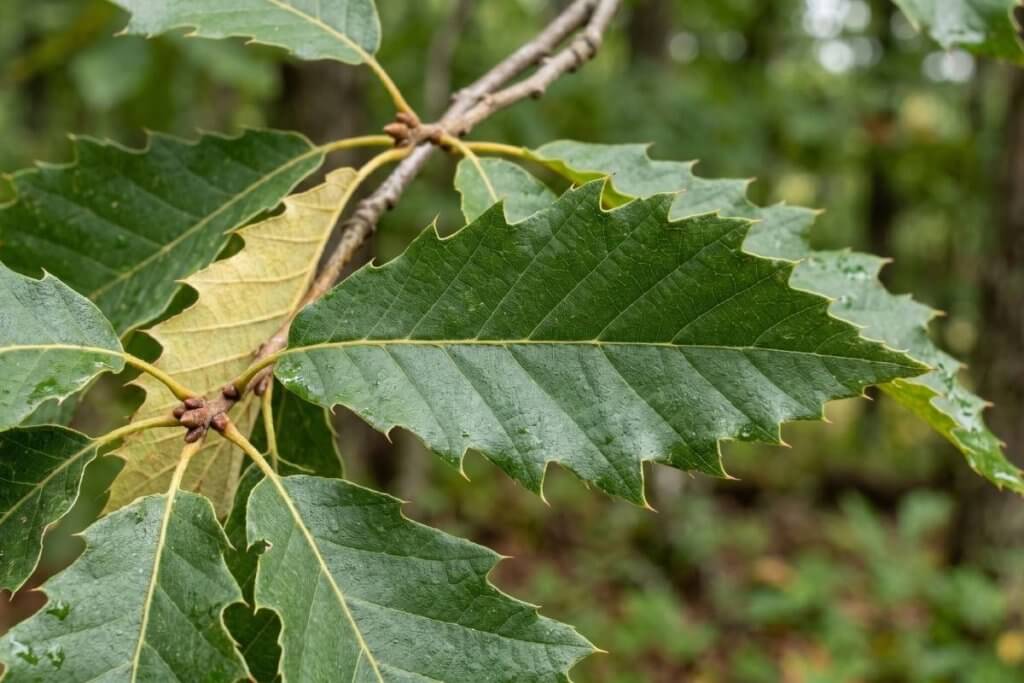
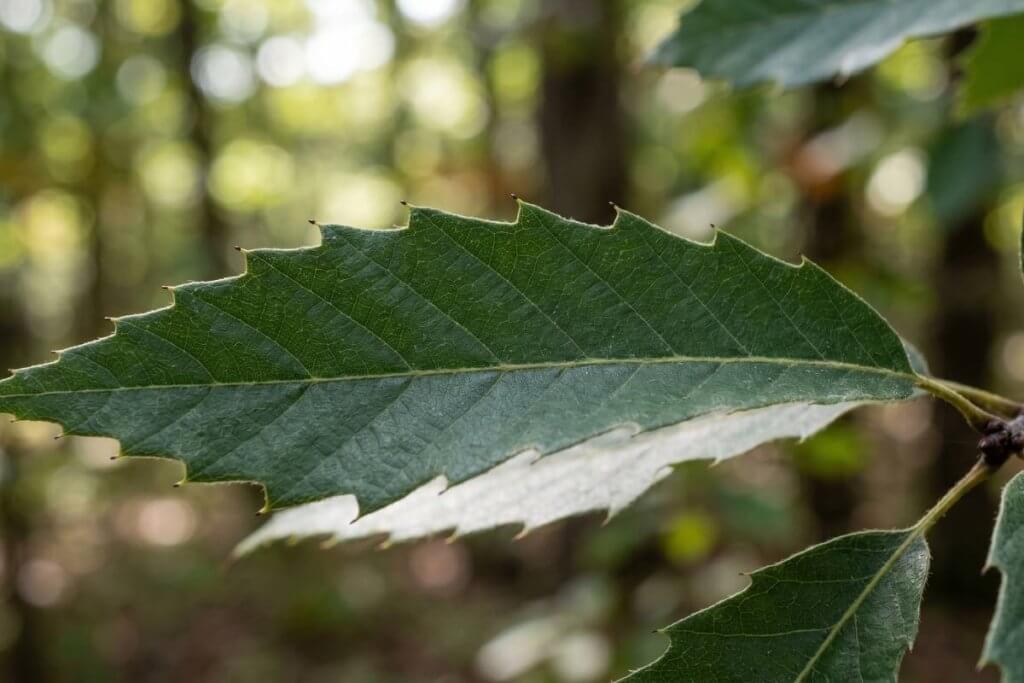
Leaves are alternate, simple, 4 to 8 inches long and 1 to 3½ inches wide, broadest near the base or above the middle. The margin is distinctively coarsely serrated or wavy along its entire length, with 8 to 13 teeth per side. Each tooth ends in a point, and the underside is paler than the top with gray hairs and conspicuous veins.
The pointed teeth are the most reliable diagnostic feature in the field. The tips of the lobes on chinkapin oak leaves carry small glands best seen with a hand lens. Chestnut oak leaf lobes lack these glands entirely.
Bark
Bark is ashy gray with shallow grooves and short, flaky ridges. This is one of the easiest visual separators from chestnut oak, which has deep, dark, blocky furrows. Chinkapin oak’s gray, flaky bark carries a slight yellow-brown cast, which is why the tree is sometimes called “yellow oak.”
On young trees, the bark remains relatively smooth. Flaking plates develop with maturity and become diagnostic once you’ve seen them a few times.
Acorns
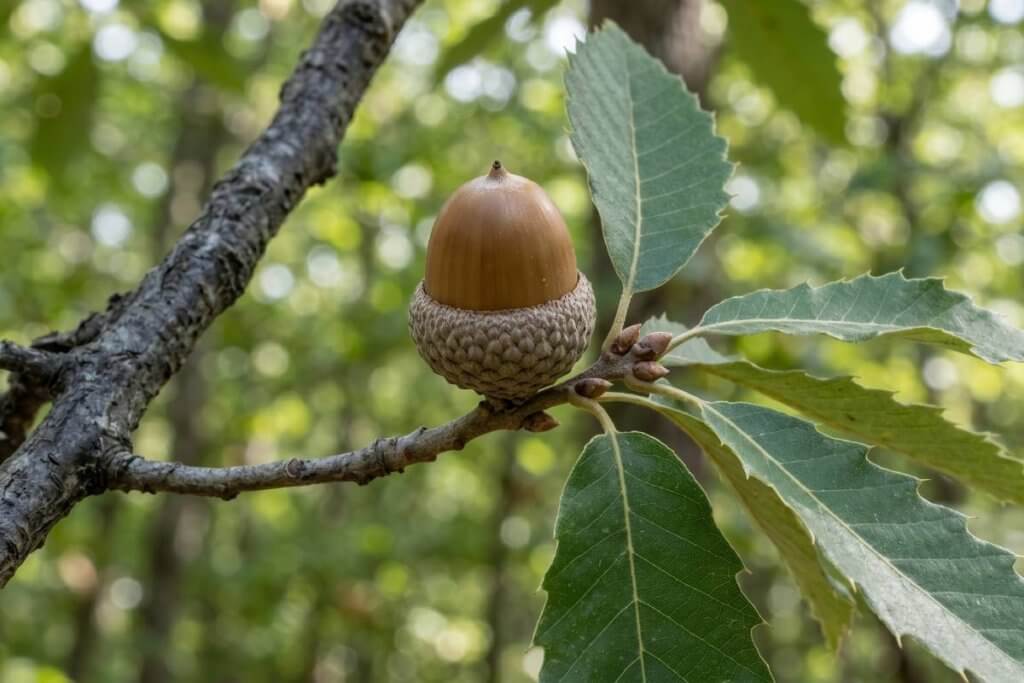
Acorns are mostly solitary or in pairs, nut brown and shiny, broadest near the base and tapering slightly to the tip, ½ to ¾ inch long. The cup is bowl-shaped, thin, and hairy, covering about half the nut. The seed is sweet and edible, ripening in autumn of the first year.
Unlike red oak group counterparts like Shumard oak, which produce bitter tannin-heavy acorns that take two years to mature, chinquapin oak acorns ripen in a single season and are noticeably sweeter.
Among oaks in Illinois, the acorns of chinkapin oak are considered less bitter and more edible than most other species. Wildlife value is high: white-tailed deer, wild turkey, squirrels, and multiple bird species feed on them heavily in the fall.
Habitat and Range
Chinkapin oak grows in alkaline soils on limestone outcrops and well-drained slopes of the uplands, usually with other hardwoods. It seldom grows in sufficient size or abundance to be commercially important, but the heavy wood makes excellent fuel.
The tree is generally found on weakly acidic soils (pH about 6.5) to alkaline (above pH 7.0), making it unusual among white oaks, most of which prefer acidic substrates.
Among white oaks that share chinquapin oak’s preference for calcareous substrates, bur oak’s tolerance for alkaline and compacted soils makes it one of the few species that occupies an overlapping native range in the upper Midwest.
Its range extends from Vermont to Minnesota, south to the Florida panhandle, and west to New Mexico. In Canada, it is found only in southern Ontario; in Mexico, it ranges from Coahuila south to Hidalgo.
According to the USDA Forest Service’s Tree Atlas, chinkapin oak occupies just 5.1% of forested area in the eastern US, classifying it as a narrowly distributed species, though it is considered common within the west-central portion of that range.
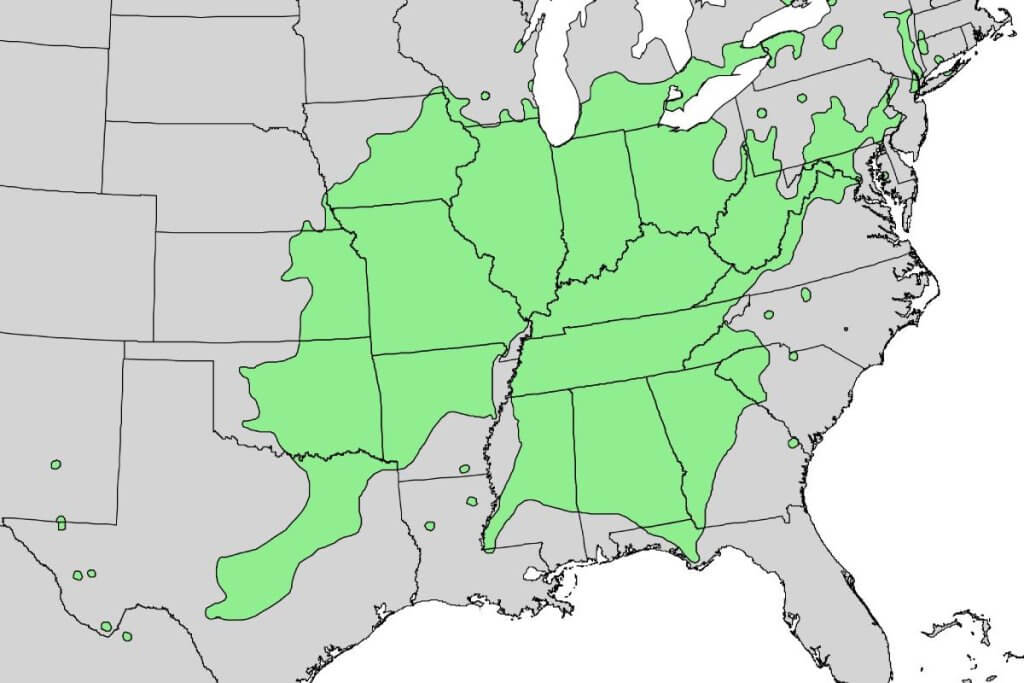 U.S. Geological Survey, Public domain, via Wikimedia Commons
Chinquapin Oak vs Look-Alike Species
This is where real identification errors happen. Three species cause repeated confusion.
Dwarf Chinkapin Oak (Q. prinoides)
Chinkapin oak is usually a tree, while dwarf chinkapin oak is a low-growing, clone-forming shrub. The two generally occupy different habitats: chinquapin oak favors calcareous soils, while dwarf chinkapin oak grows on acidic sandy substrates and dry shales.
Chestnut Oak (Q. montana)
The most common misidentification. Unlike the pointed teeth on chinkapin oak leaves, chestnut oak leaves have rounded teeth. Chinkapin oak’s bark is gray and flaky, while chestnut oak has dark, solid, deeply ridged bark. Chinkapin oak also produces smaller acorns than chestnut oak.
Ozark Chinquapin (Castanea ozarkensis)
This is not an oak at all but a true chestnut. Both species have simple, elliptical leaves with serrated margins, but the distinction becomes clear when examining the fruit: oak acorns have a cap, while Ozark chinquapins grow inside a protective, spiny burr.
Comparison Table: Chinquapin Oak vs Common Look-Alikes
| Feature | Chinquapin Oak (Q. muehlenbergii) | Chestnut Oak (Q. montana) | Dwarf Chinkapin Oak (Q. prinoides) |
| Leaf teeth | Pointed, gland-tipped | Rounded | Pointed, smaller |
| Bark | Gray, flaky/scaly | Dark, deep blocky furrows | Thin, gray-brown |
| Acorn size | ½–¾ inch | 1–1½ inch (large) | ½ inch or less |
| Acorn cup | Bowl-shaped, covers ½ nut | Conical, covers ½ nut | Thin, covers ¼–½ nut |
| Growth form | Medium to large tree | Medium to large tree | Low shrub |
| Soil preference | Alkaline, limestone | Acidic, rocky uplands | Acidic, sandy/shale |
| Typical height | 40–80 ft | 60–70 ft | 3–10 ft |
| Range | Eastern and central US | Appalachians to Ozarks | Eastern US |
Conclusion
Chinquapin oak and chinkapin oak are not two different trees. They are the same species, Quercus muehlenbergii, identified by two variant spellings with equal botanical standing.
The tree is best identified by its coarsely pointed-toothed leaves with glandular tips, ashy gray flaky bark, small sweet acorns, and preference for alkaline limestone soils across the eastern and central United States.
FAQ
Is “chinkapin” a misspelling of “chinquapin”? No. Both spellings have appeared in botanical literature for over a century. “Chinquapin” derives from an Algonquian word for the related chestnut (Castanea pumila). “Chinkapin” is a phonetic variant that spread through Midwestern regional usage. The USDA now lists both as accepted common names for Quercus muehlenbergii, though “chinquapin” appears more frequently in current peer-reviewed literature.
How do you tell chinquapin oak apart from chestnut oak in the field? Check the leaf teeth first. Chinquapin oak has pointed, gland-tipped teeth along the leaf margin; chestnut oak has distinctly rounded teeth. If you have bark access, chinquapin oak’s gray, flaky plates contrast sharply with the deep, dark furrows of chestnut oak. Acorn size is also reliable: chinquapin oak acorns run ½ to ¾ inch, while chestnut oak acorns are among the largest of any oak, often exceeding an inch.
Does chinquapin oak grow in clay or sandy soil? Neither is optimal. Chinquapin oak is a limestone specialist that performs best in well-drained alkaline soils with a pH of 6.5 or higher. It is one of the few white oaks tolerant of alkaline conditions. In cultivation, it adapts to moist fertile loams but struggles in compacted clay or acidic sandy substrates. Its long taproot makes it drought-tolerant once established but difficult to transplant after the first growing season.
What wildlife uses chinquapin oak? The sweet, low-tannin acorns attract white-tailed deer, wild turkey, blue jays, squirrels, and wood ducks. The tree is also a documented host plant for the Imperial moth (Eacles imperialis) and multiple butterfly species including the Banded hairstreak, Edward’s hairstreak, Gray hairstreak, and Horace’s duskywing. Its ecological value in oak-hickory woodland systems extends well beyond food production.