Too Long; Didn’t Read
Fresh oak leaves are acidic. Finished oak leaf compost is not.
That single distinction is what most gardening advice gets wrong, and it is responsible for a persistent myth that has cost gardeners years of unnecessarily avoiding a free, high-quality soil amendment.
If you pulled oak leaves off the tree today and tested them, the pH would sit between 4.5 and 4.7. By the time those leaves complete the composting process, the organic acids become neutralized, and mature compost generally reaches a pH between 6 and 8. That is not acidic. That is the sweet spot most garden plants prefer.
Why Fresh Oak Leaves Are Acidic
When oak leaves are fresh, they have a pH level of around 4.5 to 4.7, making them acidic. The culprit is tannin, a class of polyphenolic compounds that oak trees produce as a natural defense against insects and decay.
Tannin concentration is not uniform across the genus, and oak tree species vary in tannin content in ways that directly affect how long a fresh leaf pile takes to neutralize during the early composting phase.
Tannins are water-soluble, which is why freshly fallen leaves can temporarily lower the pH of whatever surface moisture they contact. The keyword is temporarily.
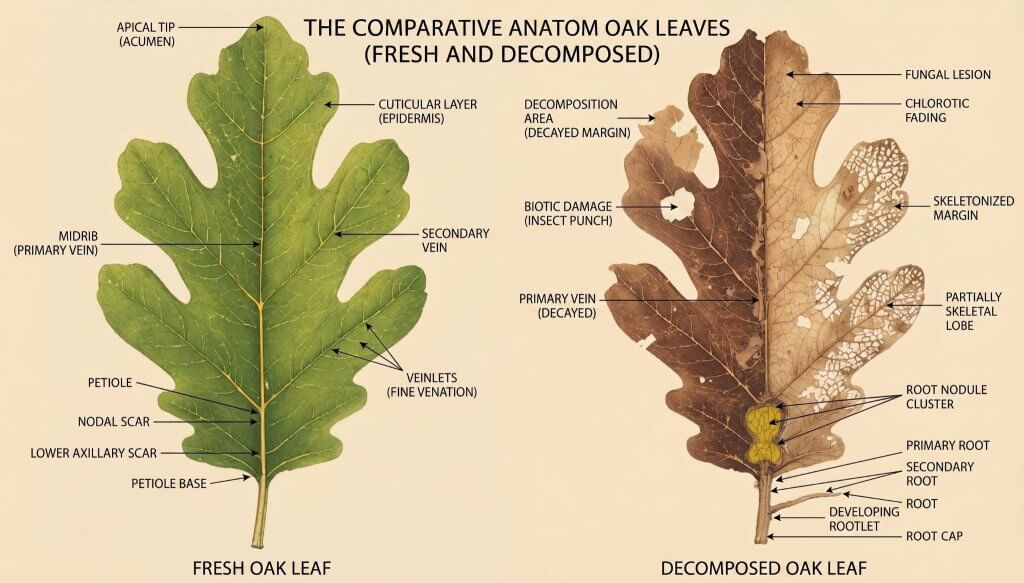
Tannin concentration varies by oak species. Red oaks and pin oaks carry higher tannin loads than white oaks or bur oaks. The higher the tannin content, the longer the initial acidity lingers during early decomposition.
What Happens to pH During Composting
The composting process runs in stages, and pH shifts with each one.
During the initial stages of decomposition, organic acids form. The acidic conditions are favorable for the growth of fungi and the breakdown of lignin and cellulose. This is why a fresh compost pile can smell sharp and test acidic in its first weeks.
As microbial activity intensifies and those organic acids get consumed, the pile’s pH climbs. A well-managed, fully mature compost pile made predominantly from oak leaves will test somewhere between 6.5 and 7.5. That is essentially neutral.
The speed of that climb depends on three variables: aeration, moisture, and the carbon-to-nitrogen ratio of your pile. Neglect any one of them and decomposition stalls in the acidic early phase.
What the Research Actually Says
The concern about oak leaves changing soil pH has been studied directly, not just theorized.
A paper published by Nikolai, Rieke, and McVay of Michigan State University documented no change in soil pH after six years of mulching oak leaves into established turf grass. The study ran from 1991 to 1997 and used 100 lbs of dry oak leaves per 1,000 sq. ft., a rate far beyond what any home gardener would apply.
Abigail A. Maynard’s research at the Connecticut Agricultural Experiment Station also documented no difference in soil pH when uncomposted leaves were added to vegetable plots.
These are not obscure blogs. These are peer-reviewed university studies. If raw, uncomposted oak leaves at heavy application rates cannot move soil pH, finished oak leaf compost at garden-amendment levels certainly will not.
Oak Leaf Compost vs. Soil pH: Not the Same Thing
Even if the compost tests at pH 6.5, applying it does not simply transfer that number to your soil. Soil pH is extraordinarily stable.
University of Missouri Extension notes that oak leaves are acidic, but pH is not a big concern with mulches, because mulch is put on top of the soil, not worked into it. Changing soil pH requires inorganic amendments like sulfur or agricultural lime applied in large quantities over multiple seasons.
One study on home composts found a mean pH of 7.0 to 7.5, and Washington State says home compost is usually around 7.5. Spreading compost in that range on average garden soil does nothing measurable to pH.
The only edge case worth watching: only very sandy soils are susceptible to pH changes due to mulch. If your garden sits on fast-draining sandy loam and you are burying large volumes of unfinished oak leaf compost directly into the root zone, test your soil pH before and after. Everyone else can stop worrying.
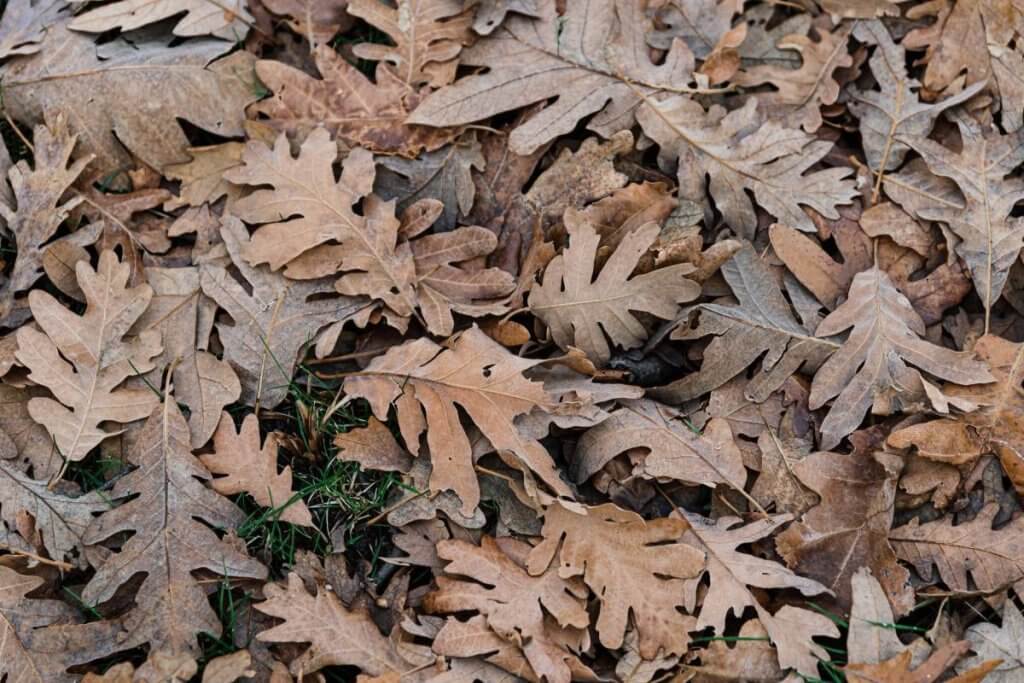
When Acidic Oak Compost Is Actually Useful
There is a scenario where you want oak leaf compost to lean acidic: acid-loving plants.
Purposefully acidic compost with a pH of 4 to 5 is called ericaceous compost. Flowering plants in the Ericaceae family, such as azaleas and rhododendrons, and other acid-loving plants like blueberries, highbush cranberries, and citrus, prefer ericaceous compost.
To push oak leaf compost toward that ericaceous range, you compost it hot and fast with minimal nitrogen inputs, limiting the neutralization that comes from intense microbial activity. Add green pine needles or citrus peels to keep the pH suppressed.
[Image: Blueberry plant in acidic garden bed with leaf mulch | Alt text: Blueberry bush thriving in acidic soil amended with oak leaf compost]
For most vegetables, lawns, and flowering perennials, finished oak leaf compost at neutral pH is exactly what you want. Apply it freely.
How to Compost Oak Leaves Correctly
Leaf volume matters when building a compost pile, and oak trees suited to smaller gardens tend to produce a more manageable annual yield of leaves, making it easier to maintain the right carbon-to-nitrogen ratio without overwhelming the pile.
Oak leaves are carbon-heavy browns. Without adequate nitrogen, they decompose slowly and can stall the pile at a lower pH.
Shred first.
Shredded leaves will decompose faster, so your lawn can benefit sooner, and shredded leaves will also take up less room in your compost. Whole oak leaves are waxy and leathery. They mat together, blocking airflow and creating the anaerobic pockets that trap organic acids.
Balance your greens.
Aim for a roughly 25:1 carbon-to-nitrogen ratio. One part grass clippings, coffee grounds, or kitchen scraps for every three to four parts oak leaves by volume gets you close.
Balancing oak leaves with nitrogen-rich greens like grass clippings or kitchen scraps is one of the core principles covered when selecting the best materials for composting, as carbon-heavy browns alone will stall decomposition and lock the pile at a lower pH for longer.
Turn the pile regularly.
If anaerobic conditions develop during composting, organic acids may accumulate rather than break down. Aerating or mixing the system should reduce this acidity.
Wait for maturity.
Finished oak leaf compost looks dark, crumbles easily, smells like forest floor, and tests at pH 6.5–7.5. If it still smells sharp or shows visible leaf structure, it is not done.
pH Comparison: Oak Leaf Compost vs. Other Amendments
| Amendment | Typical pH Range | Acidic Effect on Soil? |
| Finished oak leaf compost | 6.5–7.5 | No |
| Fresh oak leaves | 4.5–4.7 | Temporary, minor |
| Finished mixed compost | 6.0–8.0 | No |
| Bark compost | 5.4–6.0 | Minimal |
| Peat moss | 3.5–4.5 | Yes, significant |
| Agricultural sulfur | 2.0–4.0 | Yes, strong |
| Garden lime | 8.0–9.0 | Raises pH |
| Ericaceous compost | 4.0–5.0 | Yes, intended use |
Sources: Cornell Composting, Garden MythsConclusion
Oak leaf compost is not acidic once it has fully matured. Fresh oak leaves start at pH 4.5–4.7, but the decomposition process neutralizes those organic acids and pushes finished compost toward a near-neutral pH of 6.5–7.5. University research confirms that even heavy applications of raw oak leaves fail to shift soil pH in any measurable, lasting way. Use your finished oak leaf compost without hesitation.
FAQs
Will oak leaf compost make my soil too acidic for vegetables? No. Finished oak leaf compost tests at pH 6.5–7.5, which falls within the ideal range for most vegetables. The acidic tannins in fresh oak leaves break down during composting. Applying mature, finished compost will not shift your soil pH to a level that harms vegetable crops.
How long does it take for oak leaf compost to neutralize? A shredded, actively managed pile with adequate nitrogen typically reaches a neutral pH in four to six months. A cold, unmanaged pile of whole leaves can take one to two years. Shredding, turning, and balancing greens to browns are the three variables that control the timeline most directly.
Can I use oak leaf compost on blueberries or azaleas? Yes, but you need compost that is still on the acidic side, ideally pH 4.5–5.5. Fully mature, neutral oak leaf compost will not provide the acidity acid-lovers need. To keep pH lower, compost quickly with minimal nitrogen and consider mixing in pine needles or peat moss, which genuinely hold their acidity.
Is oak leaf compost different from oak leaf mulch in terms of pH? Yes. Mulch sits on top of soil and decomposes slowly in place, with minimal pH transfer to the soil beneath. Compost is a finished product worked into the soil. Both are near-neutral by the time they are ready to use, but mulch has even less contact with soil chemistry than incorporated compost does.