You found the tree. Now you need to know if your land can actually grow it. Planting a northern red oak in the wrong soil or the wrong region does not produce a slow grower; it produces a declining one.
Alkaline soil alone triggers iron chlorosis that can put a tree in permanent decline within a few seasons.
This guide gives you the exact geographic range, soil chemistry, drainage requirements, and climate thresholds the northern red oak needs to perform at its best.
Native Range: Where They Already Thrive
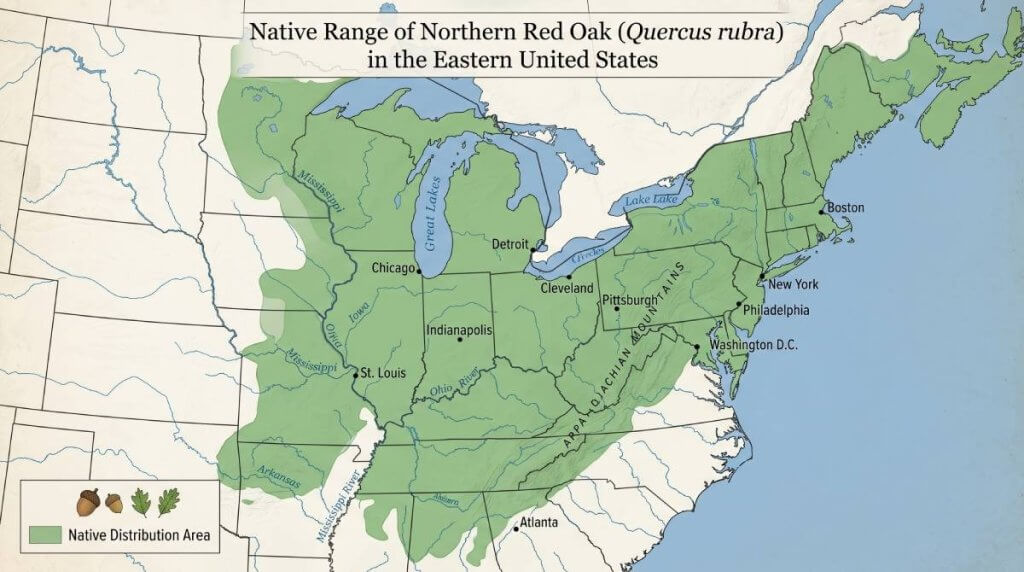
The northern red oak (Quercus rubra) is native to the eastern half of North America, spanning from Nova Scotia and southern Quebec down through the Appalachians into northern Georgia, and west through the Great Lakes states into eastern Kansas and Nebraska. It is one of the most widespread oaks on the continent.
According to the USDA Forest Service Climate Change Atlas, northern red oak occupies 24.4% of forested area in the eastern U.S., more than any other oak except white oak, and ranks sixth overall among all tree species.
That coverage is not accidental. The species evolved across a wide range of latitudes and elevations, which is exactly why it adapts well to planting outside its native range when soil and drainage conditions are met.
USDA Hardiness Zones
Northern red oaks are highly resistant to frost and thrive in the cold, wet winters and hot, humid summers of the Northeast and Mid-Atlantic, performing reliably in USDA hardiness zones 3 through 8.
Zone 3 represents the northern limit, covering parts of Minnesota, Wisconsin, and Michigan’s Upper Peninsula. Zone 8 represents the southern limit, touching parts of Georgia, Alabama, and the Pacific Northwest. The species hits peak size and health in zones 5 through 7.
The University of Florida’s IFAS Extension narrows the optimal planting range to USDA zones 5A through 8A, where it performs best in full sun or part shade in well-drained soil with a pH below 7.5.
Plant it outside zone 3 to the north, and it struggles with short growing seasons. Push it into zone 9 or beyond, and the winter chill deficit disrupts dormancy and weakens the tree over time.
Ideal Soil Conditions
Soil Type
Northern red oak performs best in moist, well-drained loams and sandy loams. It tolerates clay and sandy soils as long as drainage is not obstructed. Compacted clay with standing water is where growth stalls and root rot sets in.
On good sites in the Appalachians, dominant and codominant northern red oaks in even-aged stands can reach average annual diameter growth rates of about 10 mm (0.4 in) by age 50 to 60, compared to roughly 6 mm (0.25 in) on average sites. Soil quality is the single biggest lever on long-term yield.
Soil pH
The target range is pH 4.5 to 6.5. If soil pH rises above 7.5, leaves begin to yellow due to iron deficiency — a condition that is difficult to treat and can cause a slow decline in tree health over time.
Alkaline soils lock iron into a form the roots cannot absorb. The tree may survive, but it will not thrive. A soil test before planting is the minimum due diligence.
Drainage
Good drainage is non-negotiable. The roots need oxygen exchange. Waterlogged conditions starve roots of oxygen and create conditions for Phytophthora root rot and other fungal pathogens. If you have heavy clay, amend with coarse sand and organic matter, or plant on a slope where natural drainage occurs.
Sunlight and Climate Requirements
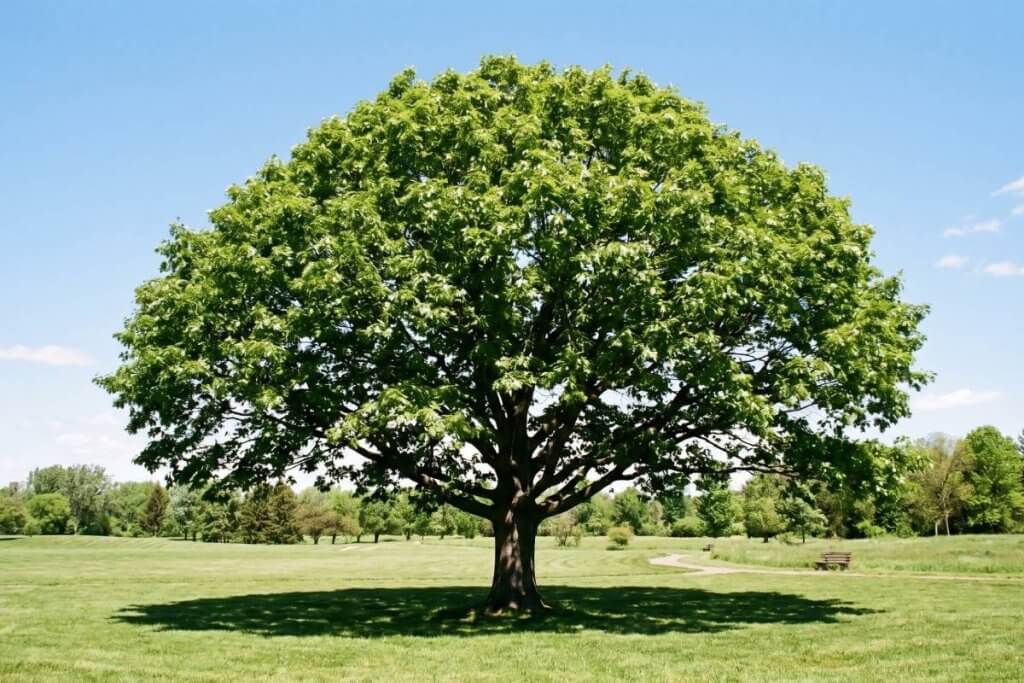
Northern red oak needs full sun, defined as six or more hours of direct sunlight per day. Light intensity is the most critical factor affecting not only the first-year survival of seedlings, but also their survival and growth in subsequent years.
Northern red oak reaches maximum photosynthesis at around 30% of full sunlight as a seedling, but needs full exposure as a mature tree to develop a dominant canopy. Planting in deep shade stunts crown development and suppresses diameter growth.
On climate, the species performs best where annual precipitation falls between 760 mm and 2,000 mm (30 to 80 inches), distributed across the growing season. Research on trees near the northern range limit found that summer moisture metrics were consistently and positively associated with growth, while higher summer temperatures were often negatively associated with growth at lower elevations.
Translation: heat stress in summer, without adequate soil moisture, curtails growth even in zones where the tree is technically hardy.
Regional Performance Breakdown
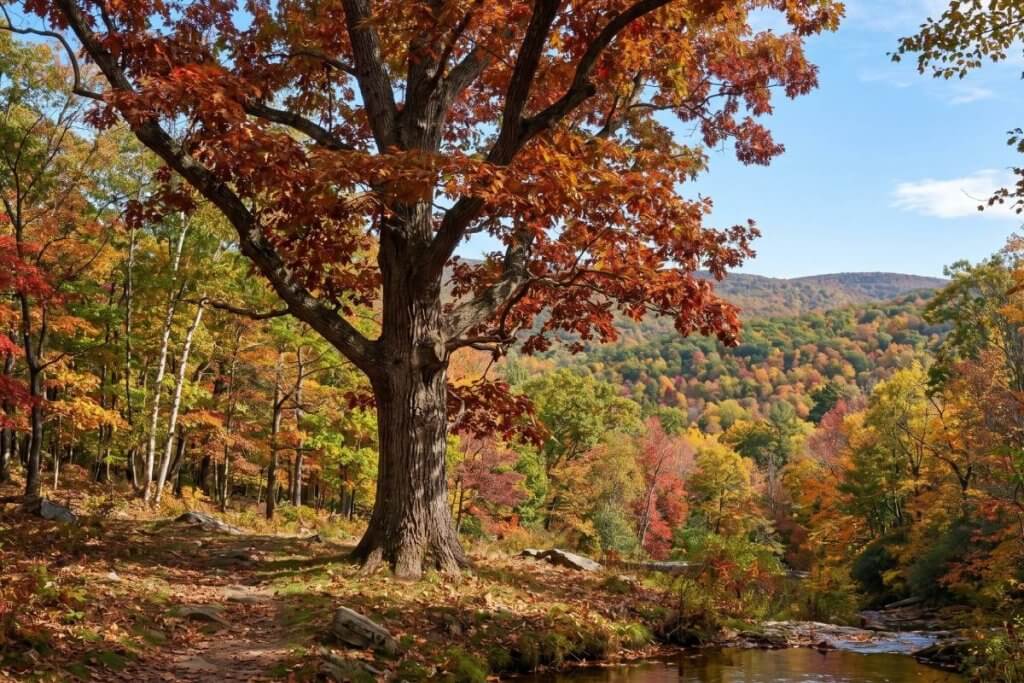
Mid-Atlantic and Appalachians (Zones 5-7) Optimal
This is the heart of the species’ range and where specimens reach their largest size. Homeowners choosing between species should compare the types of oak trees suited to residential yards before committing to a planting site, since root spread, canopy width, and soil tolerance vary significantly across the genus. Pennsylvania, West Virginia, Virginia, and North Carolina provide the acidic, loamy soils and mixed precipitation patterns that suit northern red oak best. The majority of northern red oak growing stock volume is found on dry-mesic and mesic habitat types, and over 70% of volume is located on sites with a site index greater than 60.
New England (Zones 4-6) Excellent
Connecticut, Massachusetts, and southern Vermont and New Hampshire support healthy, fast-growing stands. Cooler summers keep heat stress low. Soils tend to be naturally acidic from glacial deposits and organic matter accumulation.
Great Lakes Region (Zones 4-6) Strong
Michigan, Wisconsin, and Minnesota provide the cold winters and acidic soils that the species handles well. Growth rates here are slightly lower than in the Mid-Atlantic, but the tree remains structurally sound and long-lived.
Southeast (Zones 7-8) Marginal
Northern red oak becomes less competitive south of zone 7, where southern red oak (Quercus falcata) is better adapted. Summer heat and lower elevation drought stress limit performance in Georgia, Alabama, and Mississippi.
Great Plains (Zones 4-6) Challenging
Adequate hardiness exists, but limited annual rainfall and alkaline prairie soils make establishment difficult without irrigation and soil amendment. Not the first-choice species for this region.
Site Conditions to Avoid
These conditions either kill the tree slowly or prevent it from ever reaching its structural potential:
High soil pH (above 7.5)
Iron chlorosis sets in. Leaves turn yellow between green veins. The tree does not recover quickly, and treatment with chelated iron provides only temporary relief.
Poorly drained or compacted soil
Oxygen cannot reach the roots. On sites with poor drainage or elevated soil pH where northern red oak declines, bur oak and swamp white oak both offer stronger tolerance for wet, alkaline, and compacted conditions. Diameter growth slows, and the tree becomes susceptible to opportunistic pathogens.
Deep shade
A young tree can tolerate partial shade for the first few years. A mature tree needs full sun to sustain crown development.
USDA zones 9 and above
Insufficient winter chilling disrupts dormancy cycles. The tree weakens over successive growing seasons.
Severe drought sites
Northern red oak seedlings are less drought-tolerant than white or black oak seedlings.On sites with no reliable soil moisture during dry periods, competing species outperform it.
Quick-Reference Comparison Table
| Growing Factor | Optimal | Acceptable | Avoid |
| USDA Hardiness Zone | 5–7 | 3–4, 8 | Zone 9+ |
| Soil pH | 4.5–6.5 | 6.5–7.4 | 7.5+ |
| Soil Type | Sandy loam, loam | Clay loam, sandy | Compacted clay, pure sand |
| Drainage | Well-drained | Moderate | Waterlogged |
| Sunlight | Full sun (6+ hrs) | Part shade | Deep shade |
| Annual Precipitation | 760–2,000 mm | 500–760 mm | Below 500 mm without irrigation |
| Region | Mid-Atlantic, New England, Great Lakes | Southeast (z7-8), Upper Midwest | Great Plains (without amendment) |
Conclusion
Northern red oak grows best in USDA zones 3 through 8, on moist, well-drained, acidic soil with a pH between 4.5 and 6.5, and in full sun. The Mid-Atlantic, New England, and Great Lakes regions consistently produce the largest, healthiest specimens because they deliver exactly those conditions. Match the soil chemistry and drainage before you plant, and this tree will outperform most species in its class for generations.
FAQ
What states are northern red oaks native to? Northern red oak is native to most of the eastern United States and parts of southeastern Canada. Its core states include Pennsylvania, New York, Virginia, West Virginia, Ohio, Michigan, Wisconsin, Minnesota, and New England. It also grows naturally through the Appalachians into Georgia and North Carolina. Planting within this native range nearly always gives the best results because soils and climate already match what the species evolved with.
Can northern red oak grow in clay soil? Northern red oak tolerates clay soil but does not thrive in it when drainage is poor. Clay with good structure and adequate aeration can support healthy growth. The problem is dense, compacted clay that holds water after rain. That condition starves roots of oxygen and increases disease risk. If you have clay soil, plant on a slope or raised area where water drains away naturally, and work in organic matter before planting.
What soil pH kills a northern red oak? A soil pH above 7.5 triggers iron chlorosis, where the tree cannot absorb enough iron to support healthy leaf development. Leaves turn yellow between the veins while the veins stay green. Prolonged exposure to alkaline soil puts the tree in a slow decline that is difficult to reverse. The ideal pH window is 4.5 to 6.5. Test your soil before planting and amend with sulfur or acidic compost if necessary.
How fast does a northern red oak grow on a good site? On a high-quality mesic site in the Appalachians, dominant northern red oaks in managed even-aged stands can achieve annual diameter growth of approximately 10 mm (0.4 in) per year by age 50 to 60. On average, the rate drops to around 6 mm (0.25 in) per year. Full sun, well-drained loamy soil, and adequate growing-season moisture are the three variables most directly tied to growth rate. Reduce any one of them, and the growth rate responds accordingly.